 You are in our Global Site


Jun 09 , 2026
Modern manufacturing lines depend on stable material handling systems to maintain production efficiency, dimensional accuracy, and continuous operation. In industries such as roll forming, metal stamping, slitting, and tube production, steel coils must be fed into downstream equipment under controlled conditions to avoid production interruptions.
A decoiler machine is an industrial system designed to unwind metal coils in a controlled and synchronized manner so material can be continuously supplied into downstream processing equipment.
As production environments become increasingly automated, decoilers are no longer treated as simple support equipment. Their operational performance directly affects feeding stability, line synchronization, equipment protection, and overall manufacturing efficiency.
In coil-fed manufacturing systems, production stability depends heavily on consistent material feeding. If steel coils unwind too quickly, too slowly, or unevenly, downstream equipment may experience alignment problems, profile deformation, or unnecessary shutdowns.
This is why decoiling systems play a central role in modern metal manufacturing. Instead of relying on manual coil handling, manufacturers use decoilers to maintain continuous feeding conditions throughout long production cycles.
In industrial production discussions, the phrase what is the function of a decoiler machine is closely connected to operational stability rather than simple material unwinding.
The decoiler helps manufacturers achieve several important production goals:
Stable coil feeding
Continuous production flow
Reduced material deviation
Improved line synchronization
These factors become especially important in high-speed production lines where even small feeding inconsistencies may affect downstream forming precision.
| Production Factor | Impact on Manufacturing |
|---|---|
| Coil Tension Stability | Improves forming accuracy |
| Feeding Consistency | Reduces material deviation |
| Controlled Uncoiling | Protects downstream equipment |
| Production Synchronization | Minimizes downtime risk |
In automated roll forming environments, stable decoiling performance helps maintain dimensional consistency across long production runs.
The core function of a decoiler machine is to control how metal coil material enters the production line. This includes supporting the steel coil, regulating uncoiling speed, maintaining feeding tension, and coordinating material flow with downstream equipment.
Unlike basic manual coil holders, modern decoilers function as part of an integrated production system. Their role is directly connected to line efficiency and process stability.
Smartech Machinery decoilers are designed for continuous production applications and are commonly integrated with roll forming systems, slitting lines, and other coil-fed manufacturing equipment.
| Function | Purpose |
|---|---|
| Coil Holding | Supports heavy steel coils securely |
| Feeding Regulation | Controls material flow speed |
| Tension Coordination | Prevents unstable uncoiling |
| Line Synchronization | Matches downstream production speed |
| Coil Positioning | Maintains feeding alignment |
In modern production systems, decoilers often work continuously for extended operating periods. As a result, feeding stability becomes essential not only for product quality, but also for reducing unnecessary wear on downstream machinery.
For example, unstable feeding may lead to:
Misaligned forming profiles
Increased scrap generation
Punching inaccuracies
Production interruptions
This is why decoiler functionality is closely tied to overall production performance in industrial manufacturing.
One of the most important roles of a decoiler is maintaining stable feeding conditions throughout the production cycle. Modern decoiling systems achieve this through coordinated mechanical, hydraulic, and electrical control systems.
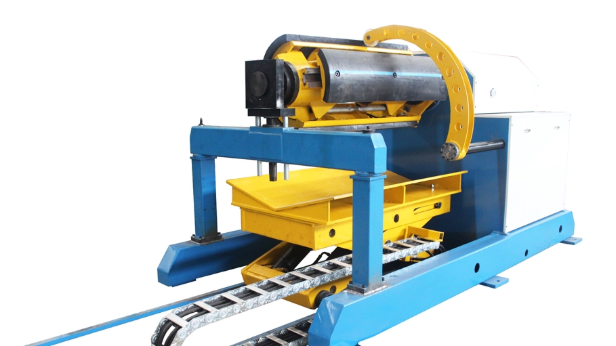
Most industrial decoilers use expandable mandrels combined with hydraulic systems to secure heavy steel coils. The drive motor controls coil rotation speed, while braking systems help regulate feeding tension during operation.
Smartech Machinery decoilers commonly use cantilever-type structures, hydraulic expansion systems, and independently controlled electric systems to support stable uncoiling operations.
Several systems work together to maintain feeding performance:
| System | Operational Role |
|---|---|
| Hydraulic Expansion System | Secures the steel coil |
| Drive Motor System | Controls uncoiling speed |
| Braking System | Maintains tension balance |
| Electric Control System | Coordinates machine movement |
| Ultrasonic Sensors | Adjust feeding synchronization |
In high-volume manufacturing environments, synchronization between the decoiler and downstream equipment becomes especially important. If material feeds faster than the forming machine can process it, coil instability may occur. If feeding becomes too slow, production efficiency may decrease.
This is why many automated production lines use sensor-controlled synchronization systems to maintain balanced feeding conditions.
Automation has significantly improved the operational capabilities of modern decoiler systems. Earlier production lines often relied on manual adjustments, which increased the risk of inconsistent feeding and operator error.
Today, automated decoilers use PLC systems, hydraulic controls, and variable speed drives to improve production coordination.
Smartech Machinery decoilers may integrate:
PLC automation systems
Ultrasonic feeding sensors
Hydraulic control systems
Variable speed motor drives
These technologies help coordinate the decoiler with downstream equipment while improving long-term production consistency.
| Automation Feature | Production Benefit |
|---|---|
| PLC Control | Reduces manual intervention |
| Sensor Synchronization | Improves feeding consistency |
| Variable Speed Control | Supports energy efficiency |
| Hydraulic Automation | Simplifies coil handling |
Automation also improves production reliability because the decoiler can respond more quickly to changes in downstream production speed.
Although decoilers improve production efficiency, maintaining stable operational performance requires regular inspection and proper machine control.
One of the most common operational challenges is inconsistent feeding tension. If braking systems or synchronization controls become unstable, downstream forming accuracy may be affected.
Additional operational issues may include:
Hydraulic leakage
Coil misalignment
Mandrel wear
Motor overload
Poor maintenance conditions may gradually reduce production stability over time. Dust accumulation, insufficient lubrication, and excessive operating temperatures can all increase wear on mechanical systems.
Smartech Machinery recommends regular lubrication, alignment inspection, and hydraulic system maintenance to support long-term operational stability.
In large production environments, even minor feeding instability may affect:
Production continuity
Material utilization
Downstream equipment lifespan
Product consistency
For this reason, many manufacturers treat decoiler maintenance as part of their overall production efficiency strategy.
The operational function of a decoiler becomes increasingly important in industries that rely on continuous coil-fed manufacturing systems.
For example, roll forming lines require stable feeding tension to maintain profile consistency during long production runs. In metal stamping operations, synchronized feeding helps maintain die accuracy and reduces material waste.
| Industry | Why Decoiler Function Is Important |
|---|---|
| Roll Forming | Supports continuous profile feeding |
| Metal Stamping | Maintains feeding accuracy |
| Slitting Lines | Controls strip tension stability |
| Pipe Manufacturing | Improves material alignment consistency |
Heavy-duty decoilers with hydraulic systems and coil cars are particularly important when processing large steel coils in high-volume industrial production environments.
As industrial automation continues to evolve, decoilers increasingly function as integrated production-control systems rather than simple mechanical coil holders.
Modern decoiler machines do far more than unwind steel coils. Their functions directly influence feeding stability, production synchronization, downstream equipment protection, and overall manufacturing efficiency. In automated metal processing environments, reliable decoiler performance remains essential for maintaining consistent and continuous production operations.
A decoiler machine controls the unwinding and feeding of metal coils into downstream manufacturing equipment.
Proper synchronization helps maintain production stability and reduces downstream processing errors.
Automation improves feeding consistency, reduces manual adjustment, and supports continuous production flow.
Roll forming, stamping, slitting, and pipe manufacturing industries commonly use decoiler machines.
Hydraulic leakage, feeding instability, coil misalignment, and mandrel wear are among the most common issues.
Wikipedia – Coil Processing
https://en.wikipedia.org/wiki/Coil_processing
Encyclopaedia Britannica – Metalworking
https://www.britannica.com/topic/metalwork