 You are in our Global Site


Jun 09 , 2026
In modern metal processing, the decoiling process is a critical step in ensuring smooth and efficient production. A decoiler machine unwinds steel coils or other metal strips in a controlled manner, feeding material into downstream machines such as roll formers, cutting lines, or stamping equipment. Understanding what is the process of decoiling is essential for manufacturers aiming to maximize productivity and maintain product quality.
Smartech Machinery provides a wide range of high-quality decoilers designed for industrial use. Their machines combine robust construction, advanced control systems, and efficient feeding mechanisms to meet modern production requirements.
Decoiling is more than simply unrolling metal coils; it is a process that integrates mechanical, hydraulic, and control systems to maintain stable feeding throughout production. Proper decoiling ensures consistent material tension, prevents coil deformation, and protects downstream equipment from damage.
The decoiling process includes multiple steps that must be coordinated precisely. High-volume production lines, especially in roll forming and metal stamping, rely on the decoiler to maintain continuous material flow.
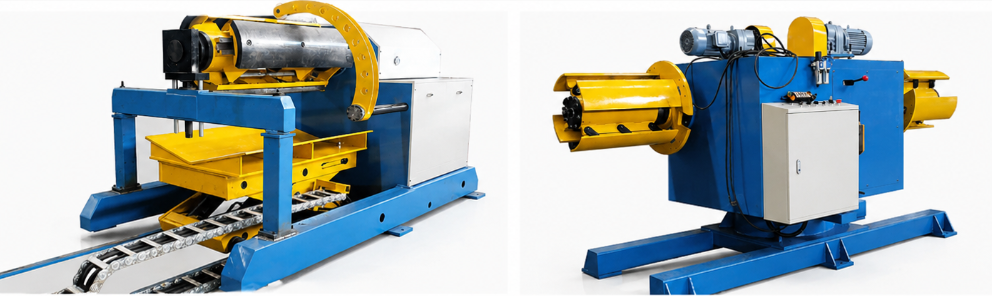
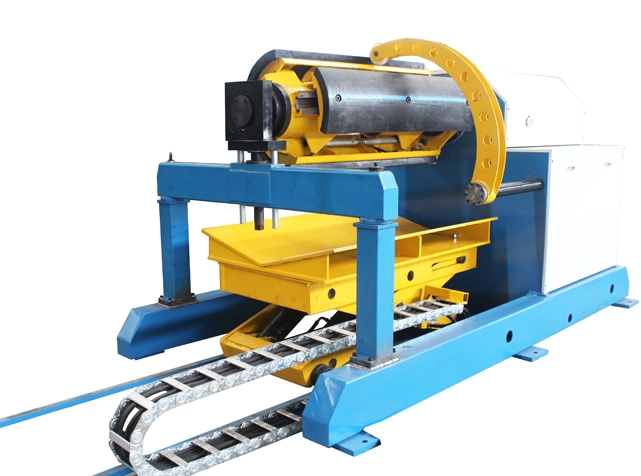
Coil loading is the first step in the decoiling process. Operators must ensure the coil is correctly positioned on the mandrel or shaft to prevent misalignment. Smartech Machinery decoilers use coil cars or lifting systems to safely and efficiently place heavy coils onto the machine.
Key actions during coil loading:
Use a coil car for safe lifting
Align the coil with the machine’s mandrel
Verify coil dimensions match mandrel expansion range
| Coil Weight | Recommended Decoiler Type | Maximum Width Supported |
|---|---|---|
| 3–5 tons | 3T / 5T Decoiler | Up to 1,250 mm |
| 8 tons | 8T Decoiler with Coil Cart | Up to 1,250 mm |
| 10–15 tons | 10T–15T Decoiler with Coil Car | Up to 1,250 mm |
Proper loading minimizes downtime and prevents material waste caused by misalignment or incorrect coil handling.
Once the coil is positioned, the mandrel expands to grip the coil securely. Smartech decoilers feature hydraulic or pneumatic systems that ensure the mandrel adjusts to different coil diameters while maintaining stable clamping.
Benefits of precise mandrel clamping:
Prevents coil slippage during unwinding
Reduces tension inconsistencies
Protects both coil and downstream equipment
During this step, the hydraulic system controls expansion pressure, while the electric control system manages mandrel movement to allow precise engagement.
Controlled unwinding is central to the decoiling process. The mandrel rotates at a speed synchronized with the production line, ensuring the coil is fed evenly.
Key mechanisms involved:
Drive motor system: Powers the mandrel rotation
Braking system: Maintains tension to prevent overspinning
Sensors and PLC control: Adjust speed based on line requirements
Common operational points:
Motor speed should match downstream forming or cutting speed
Ultrasonic sensors monitor coil tension
Braking prevents loose loops or irregular feed
Controlled unwinding reduces material deformation, increases precision, and ensures smooth operation throughout the production cycle.
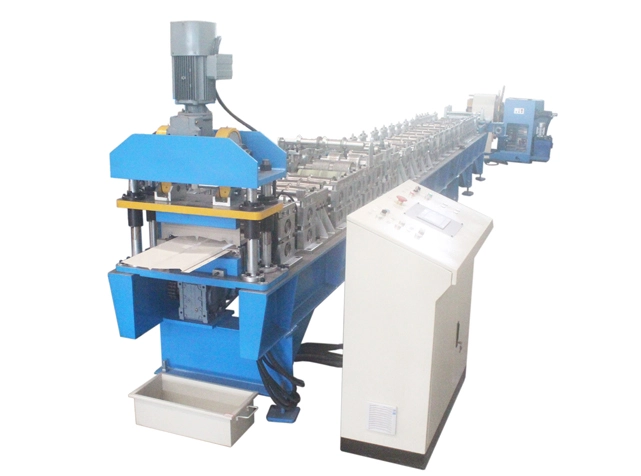
After unwinding, the material enters the production line. Smartech decoilers are compatible with roll forming machines, slitting lines, and press operations, providing a seamless transition.
Guide rollers align the strip while the entry speed is adjusted automatically to match downstream equipment. PLC integration ensures continuous, precise feeding, minimizing production stops and maintaining product quality.
This step ensures that production is uninterrupted, and that the material maintains correct orientation and tension throughout.
Maintaining consistent tension is crucial for high-quality production. Inconsistent tension can cause wrinkling, misalignment, or surface damage. Smartech Machinery decoilers use advanced tension control systems combining mechanical brakes, hydraulic adjustments, and real-time sensor feedback.
Tension control measures include:
Braking system adjustments to prevent overspinning
Feedback from tension sensors to detect slack or overload
Automated speed synchronization with downstream processes
| Tension Parameter | Recommended Value | Purpose |
|---|---|---|
| Coil feed tension | 50–150 N | Prevent deformation |
| Mandrel clamping force | 2–5 tons | Secure coil without damage |
| Entry speed variation | ±5% | Maintain production consistency |
Proper tension control reduces scrap, improves profile accuracy, and prolongs equipment lifespan.
Even with advanced decoilers, manufacturers may encounter challenges such as coil misalignment, hydraulic leaks, or mandrel wear. Environmental factors like temperature fluctuations and dust accumulation can also impact performance. Routine maintenance, proper operator training, and clean working conditions are essential to mitigate these issues and maintain smooth operation.
Automation enhances efficiency, accuracy, and energy savings in decoiling. Modern systems often include PLC control for automated operation, variable frequency drives to match motor speed with production load, and sensor networks for tension monitoring. By minimizing human error and enabling precise adjustments, automation ensures consistent coil feeding and stable downstream processing.
Automation benefits can be summarized as:
Reduced human error and downtime
Improved material handling and coil alignment
Energy-efficient operation through optimized motor control
Understanding what is the process of decoiling is essential for manufacturers aiming for high efficiency and consistent product quality. Smartech Machinery decoilers provide reliable, automated, and energy-efficient solutions for modern metal processing, ensuring safe, continuous, and precise material feeding across diverse applications.
Q1: What is the process of decoiling?
It is the controlled unwinding and feeding of metal coils into production lines, maintaining stable tension and alignment.
Q2: Why is tension control important?
Proper tension prevents coil deformation, ensures quality, and protects downstream equipment.
Q3: What industries use decoilers?
Roll forming, stamping, slitting, and pipe manufacturing industries rely on decoiler machines.
Q4: How does automation benefit decoilers?
Automation improves feeding consistency, reduces human error, and enables energy-efficient operation.
Q5: What are common decoiler maintenance practices?
Regular lubrication, alignment checks, inspection of hydraulic systems, and monitoring motor performance.
Wikipedia – Coil Processing
https://en.wikipedia.org/wiki/Coil_processing
Encyclopaedia Britannica – Metalworking
https://www.britannica.com/topic/metalwork