 You are in our Global Site


Jun 09 , 2026
Metal processing industries rely heavily on continuous material feeding systems to maintain stable production efficiency. In applications such as roll forming, stamping, slitting, and metal cutting, steel coils must be unwound smoothly and consistently before entering downstream equipment. This is where decoiler machines play an important role in modern manufacturing systems.
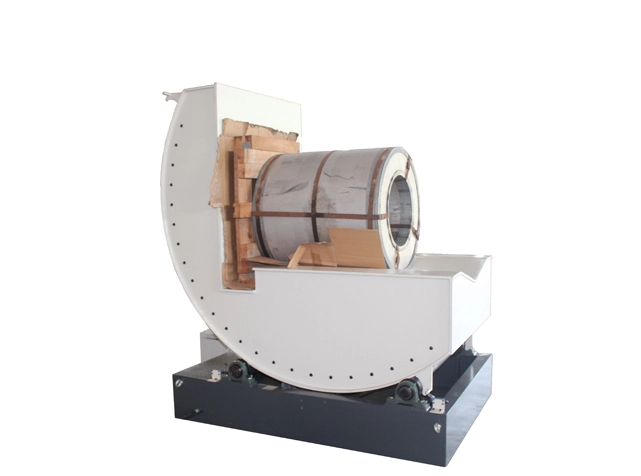
A decoiler machine is an industrial device designed to hold, support, and continuously unwind metal coils for feeding into downstream processing equipment such as roll forming machines, presses, and cutting systems.
Today, decoilers are widely used in metal fabrication environments because they improve feeding consistency, reduce manual handling, and support continuous production operations across various manufacturing lines.
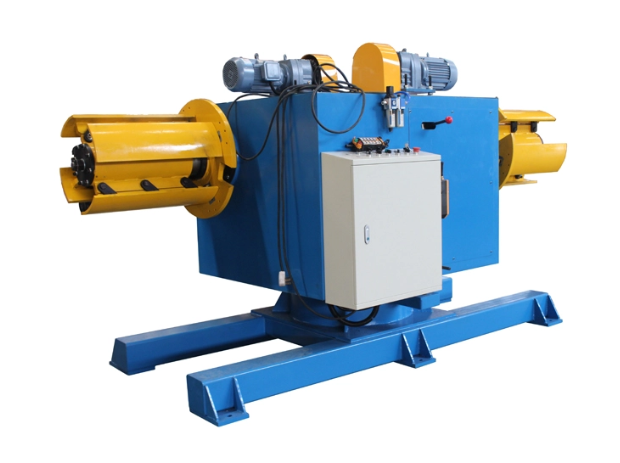
In industrial manufacturing, the phrase what is a decoiler is commonly associated with coil handling systems used in roll forming and sheet metal processing. A decoiler, also called an uncoiler, is responsible for securely holding a metal coil and unwinding the material at a controlled speed during production.
Rather than manually feeding heavy steel coils into a production line, manufacturers use decoilers to automate the uncoiling process and maintain stable material flow. This becomes especially important in high-volume production environments where feeding interruptions may reduce efficiency or affect dimensional consistency.
Smartech Machinery manufactures decoiler systems designed for continuous production environments. These machines are commonly used together with roll forming lines to support stable coil feeding and improve production continuity.
Modern decoiler systems are commonly used with:
Roll forming lines
Metal stamping systems
Slitting machines
Sheet cutting equipment
Depending on production requirements, decoilers may operate manually, electrically, hydraulically, or through fully automated control systems.
The primary purpose of a decoiler machine is to unwind metal coil safely and continuously while supplying material into downstream production equipment. Without stable coil feeding, production lines may experience material deviation, inconsistent tension, or unexpected downtime.
In many manufacturing environments, decoilers help improve:
Feeding stability
Production efficiency
Operator safety
Material handling consistency
Industries such as construction, warehousing, automotive manufacturing, and infrastructure commonly use decoilers for processing galvanized steel, stainless steel, aluminum, and pre-painted metal coils.
Smartech Machinery decoilers are designed to work alongside roll forming machines for continuous production applications. The systems typically use cantilever-type structures combined with hydraulic systems, electric controls, and coil cars to improve handling efficiency for heavy steel coils.
| Function | Production Benefit |
|---|---|
| Coil Holding | Supports heavy steel coils |
| Controlled Uncoiling | Maintains stable feeding |
| Material Alignment | Reduces feeding deviation |
| Coil Loading Support | Improves operational safety |
| Continuous Feeding | Supports automated production |
In large production facilities, automated decoilers may also synchronize feeding speed with downstream forming or cutting equipment to maintain stable production flow.
A decoiler machine operates by mounting a metal coil onto an expandable mandrel. Once secured, the mandrel rotates gradually to unwind the coil and feed material into the next stage of production.
Most decoilers use hydraulic, pneumatic, or motor-driven systems to control mandrel expansion and feeding speed. In automated production environments, sensors and PLC systems may coordinate uncoiling speed with downstream machinery to prevent excessive tension or unstable feeding.
The basic decoiling process usually includes:
Loading the steel coil
Expanding the mandrel
Controlling uncoiling speed
Feeding material downstream
Maintaining stable tension
Smartech Machinery decoilers commonly use cantilever-type expansion systems combined with motor-driven shaft systems and hydraulic controls to support continuous coil handling operations.
Although the decoiling process appears simple, feeding stability is extremely important in modern metal processing because unstable uncoiling may affect downstream forming accuracy and product consistency.
A decoiler system consists of several mechanical and control components that work together to support safe and stable uncoiling operations.
| Component | Main Function |
|---|---|
| Mandrel | Holds and expands the steel coil |
| Hydraulic System | Controls expansion and movement |
| Motor and Drive System | Powers coil rotation |
| Braking System | Controls uncoiling tension |
| Coil Car | Assists with coil loading |
| Electric Control System | Manages operation settings |
Many Smartech Machinery decoilers use hydraulic shaft expansion systems and separately controlled electric systems to support forward, backward, and step-motion operations.
Support arms and rollers may also be added for handling larger or heavier coils in industrial production environments.
Different production environments require different decoiler configurations depending on coil weight, automation level, and feeding requirements.
Common types of decoiler machines include:
Manual decoilers
Motorized decoilers
Hydraulic decoilers
Double-head decoilers
Manual decoilers are generally suitable for lighter coils and lower production volumes, while hydraulic decoilers are commonly used in heavy-duty continuous production systems.
Smartech Machinery provides several decoiler models designed for different coil-loading requirements and continuous production applications, ranging from compact systems for lighter coils to heavy-duty hydraulic decoilers with coil cars for large-scale production lines.
| Model | Typical Capacity | Main Features | Common Application |
|---|---|---|---|
| 3T Decoiler | 3-ton coil handling | Compact structure for light-duty production | Small roll forming lines |
| 5T Automatic Decoiler | 5-ton coil handling | Automatic feeding and improved production efficiency | Medium-speed automated production |
| 8T Decoiler with Coil Cart | 8-ton coil handling | Hydraulic support with coil loading cart | Continuous roll forming lines |
| 10T Uncoiler Machine | 10-ton coil handling | Heavy-duty uncoiling for larger steel coils | Structural metal processing |
| 15T Decoiler with Coil Car | 15-ton coil handling | Large-capacity hydraulic system with coil car support | High-volume industrial production |
Choosing the right decoiler depends largely on production speed, coil weight, and downstream equipment requirements.
In metal processing terminology, “decoiled pipe” generally refers to pipe or tubular material produced from coil-fed manufacturing processes. In some production systems, flat metal coil is first unwound through a decoiler and then processed through forming and welding equipment to create continuous pipe products.
The term may also describe pipe material that has been straightened or processed after being stored in coiled form for transportation purposes.
Decoiled pipe production is commonly associated with:
Tube mills
Pipe forming lines
Coil-fed welding systems
Continuous forming equipment
Stable uncoiling is especially important in pipe production because inconsistent feeding tension may affect roundness, weld quality, or dimensional accuracy during continuous forming operations.
Decoiler machines are widely used across modern manufacturing industries because they support continuous material handling and improve production stability.
| Industry | Typical Use |
|---|---|
| Construction | Roofing and wall panel production |
| Warehousing | Storage rack manufacturing |
| Automotive | Coil-fed metal stamping |
| Infrastructure | Guardrail and structural profile production |
Manufacturers often benefit from decoiler systems because they reduce manual handling requirements and support automated production flow.
Key operational advantages include:
Continuous material feeding
Improved production efficiency
Reduced operator workload
Better feeding consistency
Smartech Machinery also emphasizes regular maintenance, hydraulic inspection, lubrication, and proper alignment as important factors for improving decoiler efficiency and long-term operating stability.
Decoiler machines play an important role in modern metal processing by supporting stable coil handling and continuous material feeding. From roll forming to pipe manufacturing, decoilers help improve production efficiency, reduce manual handling, and maintain consistent processing conditions across industrial manufacturing lines.
A decoiler machine is used to hold and unwind metal coils for feeding into downstream manufacturing equipment.
Decoilers commonly process galvanized steel, stainless steel, aluminum, and other coil-based metal materials.
The two terms are often used interchangeably in metal processing industries.
Stable feeding helps maintain downstream forming accuracy and reduces production interruptions.
Construction, automotive, warehousing, and metal fabrication industries commonly use decoiler systems.
Wikipedia – Coil Processing
https://www.britannica.com/topic/metalwork
Encyclopaedia Britannica – Metalworking
https://en.wikipedia.org/wiki/Coil_processing