 You are in our Global Site


Jun 09 , 2026
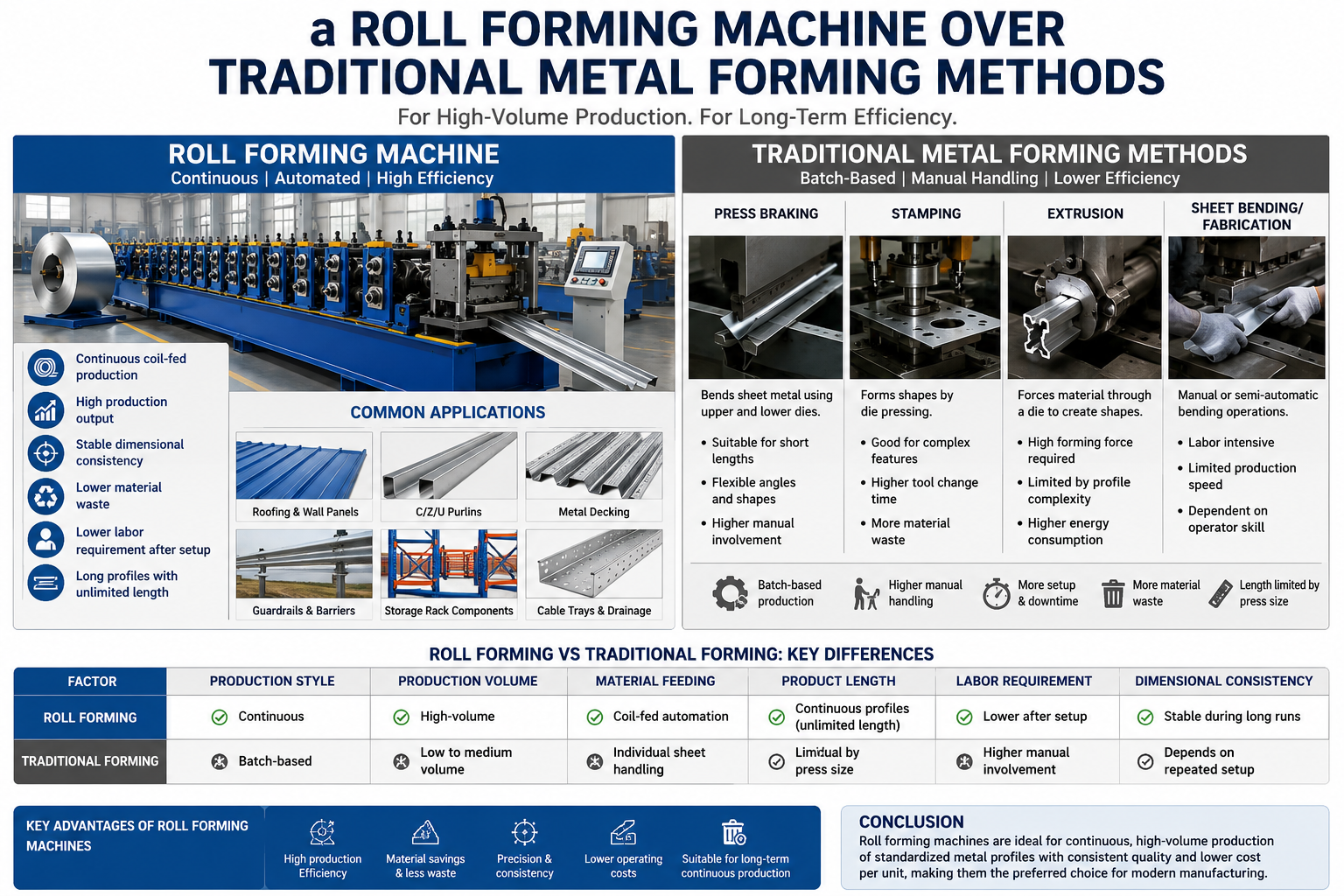
Metal forming technologies play a central role in modern manufacturing, especially in industries that require large quantities of structural or profile-based metal products. As production demands continue to increase, manufacturers are increasingly evaluating whether continuous roll forming systems provide greater long-term efficiency compared with traditional metal forming methods such as stamping, press braking, and extrusion.
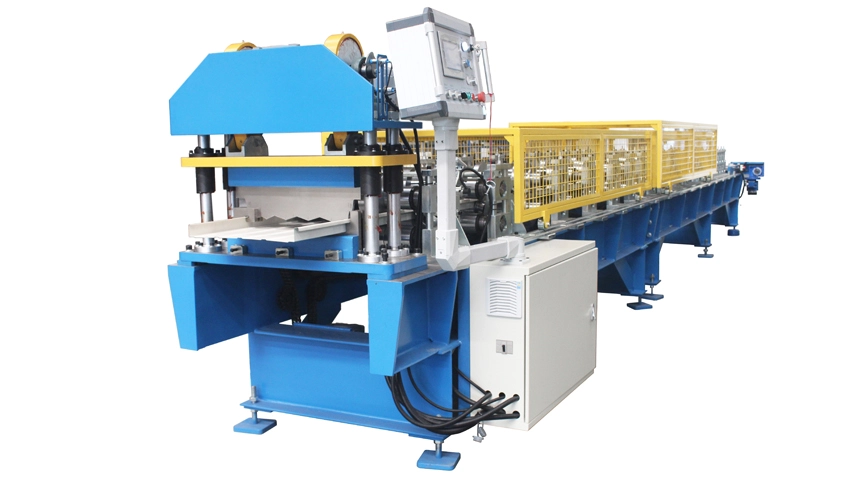
A roll forming machine is an industrial system that continuously shapes metal strip or coil into a specific cross-sectional profile through multiple forming stations arranged in sequence.
Today, industries such as construction, warehousing, transportation, and infrastructure often rely on roll forming technology because it supports continuous production, dimensional consistency, and lower material waste during large production runs.
Roll forming is a continuous bending process where metal coil passes through multiple roller stations that gradually shape the material into the required profile. Traditional forming methods, by comparison, usually rely on individual forming actions such as stamping, punching, or press braking.
Although both approaches are widely used in industrial manufacturing, they are designed for different production conditions. Roll forming is typically more suitable for long production runs and continuous profile manufacturing, while traditional forming methods are often preferred for smaller production batches or highly customized parts.
In industrial manufacturing discussions, the phrase how roll forming machine work is commonly associated with synchronized coil feeding, progressive deformation, and continuous profile shaping.
Traditional metal forming methods generally involve:
Press braking
Stamping
Extrusion
Sheet bending
These methods remain important in modern fabrication, particularly when manufacturers require flexible geometry changes or smaller production quantities.
One of the main reasons manufacturers adopt roll forming technology is its ability to support continuous high-volume production with stable dimensional consistency.
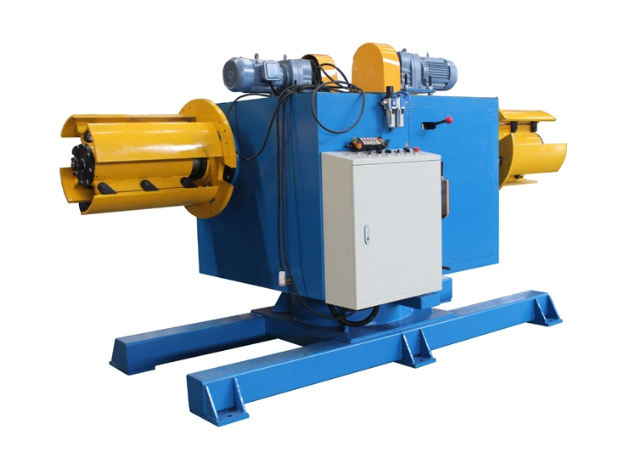
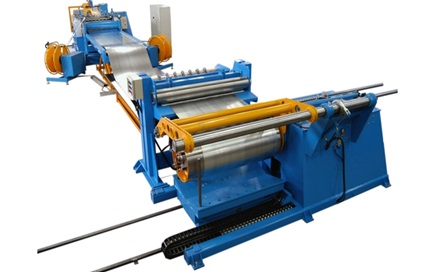
Unlike batch-based forming operations, roll forming systems operate continuously once the production line is configured. Material feeding, profile shaping, and cutting processes are synchronized through automated control systems, which helps reduce interruptions during long production runs.
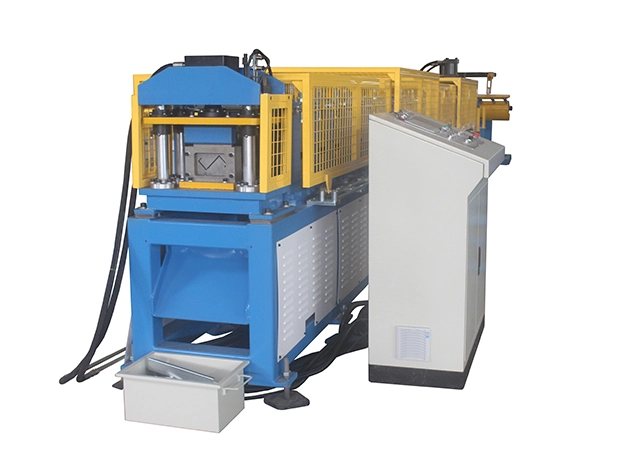
Smartech Machinery roll forming lines are engineered for continuous production environments where production stability, dimensional consistency, and long operating cycles are important. Depending on application requirements, the production line can be configured with guide column systems, surface-treated rollers, hydraulic cutting units, and automated controls.
Several operational advantages contribute to higher production output:
Continuous coil-fed processing
Reduced manual intervention
Stable forming synchronization
Faster production cycles
In many manufacturing environments, reducing downtime and maintaining production consistency are often more important than simply increasing line speed.
Although both manufacturing methods shape metal materials, their operational logic and production efficiency differ significantly.
| Factor | Roll Forming | Traditional Forming |
|---|---|---|
| Production Style | Continuous | Batch-based |
| Production Volume | High-volume | Low to medium volume |
| Material Feeding | Coil-fed automation | Individual sheet handling |
| Product Length | Continuous profiles | Limited by press size |
| Labor Requirement | Lower after setup | Higher manual involvement |
| Dimensional Consistency | Stable during long runs | Depends on repeated setup |
Traditional forming methods often provide greater flexibility for custom or low-volume fabrication. However, when manufacturers need consistent profiles over long production runs, roll forming systems usually offer better production efficiency.
Modern roll forming systems also reduce repeated handling during production, which helps maintain more stable dimensional accuracy across large batches.
Material utilization is one of the most important factors in industrial manufacturing costs. Because roll forming gradually shapes metal through sequential roller stations, the process typically generates less scrap compared with some traditional cutting and forming methods.
Continuous feeding also helps manufacturers optimize raw material usage during large production runs. According to the U.S. Environmental Protection Agency, improving manufacturing efficiency and reducing material waste can contribute to lower operating costs and more sustainable production.
Manufacturers often improve material efficiency through:
Stable feeding control
Accurate roller alignment
Automated cutting systems
Preventive maintenance practices
In addition, modern roll forming lines may integrate hydraulic cutting and automated stacking systems to reduce production interruptions and handling waste.
Dimensional consistency becomes increasingly important when production volumes are high or when products must fit standardized assembly systems.
Because roll forming uses progressive shaping rather than single-step deformation, the process helps maintain profile uniformity during continuous operation. Roller alignment, feeding synchronization, and PLC controls all contribute to production stability.
In practical production environments, manufacturers also benefit from understanding how to operate roll forming machine systems correctly, since improper feeding or setup conditions may affect dimensional accuracy during continuous production.
Roll forming systems are widely used in industries that require long metal profiles with consistent cross-sectional geometry.
Common applications include:
Roofing and wall panels
Metal decking systems
C/Z/U purlins
Guardrails and highway barriers
Storage rack components
Cable trays and drainage systems
Smartech Machinery provides customized roll forming solutions for different profile requirements and production capacities, including roofing systems, structural profiles, drainage products, and storage components.
Despite the advantages of roll forming, traditional forming methods continue to play an important role in modern manufacturing.
For example, press braking is often more practical for short production runs or products requiring frequent geometry adjustments. Stamping may also be more suitable for components with complex localized forming requirements.
Traditional methods are commonly selected when manufacturers prioritize:
Flexible tooling adjustments
Small production quantities
Customized part geometry
Lower initial equipment investment
As a result, many factories use both roll forming and traditional fabrication methods depending on product type and production volume.
Selecting the right forming method depends on production goals, material characteristics, and operational requirements rather than machine type alone.
Manufacturers usually evaluate:
| Production Factor | Recommended Consideration |
|---|---|
| Production Volume | Continuous or batch production |
| Profile Complexity | Standardized or customized geometry |
| Material Thickness | Forming compatibility |
| Dimensional Consistency | Tolerance requirements |
| Production Speed | Output expectations |
| Investment Planning | Long-term operating cost |
Roll forming is generally more suitable for standardized profiles produced in large quantities, while traditional forming methods may provide greater flexibility for low-volume or highly customized applications.
Roll forming machines are increasingly preferred in modern manufacturing because they support continuous production, stable dimensional consistency, and improved material utilization during high-volume operations. While traditional forming methods remain valuable for specialized fabrication needs, roll forming technology often provides greater long-term efficiency for standardized metal profile production.
Roll forming systems operate continuously and maintain stable production flow during long manufacturing runs.
Yes. Progressive forming and continuous feeding can help improve material utilization and reduce scrap generation.
Yes. Press braking, stamping, and other traditional methods remain useful for customized or low-volume production.
Construction, warehousing, transportation, infrastructure, and storage system industries commonly use roll forming technology.
The process uses gradual shaping through multiple roller stations, which helps maintain profile uniformity during continuous production.