 You are in our Global Site


Aug 11 , 2026
Choosing between horizontal sheet racks and an automated vertical storage system depends on more than available floor space. Sheet dimensions, material weight, retrieval frequency, workshop height, handling equipment and production workflow all affect which storage method is more practical.
Horizontal racks remain suitable for low-volume workshops with simple inventory requirements, while automated vertical storage makes better use of building height and delivers selected trays to an accessible loading position. For metal fabricators, laser cutting facilities and sheet-processing plants, the right system should improve material access without creating unnecessary handling steps or equipment costs.
A vertical storage system for sheet metal stores steel, stainless steel, aluminum or other flat materials in stacked trays arranged upward rather than across the workshop floor. The system uses the available building height to increase storage density while keeping different sheet sizes, grades and thicknesses separated.
Vertical sheet storage generally falls into two categories:
Manual vertical racks: Sheets are stored upright in divided compartments and removed manually or with lifting equipment.
Automated vertical storage: Materials are stored horizontally on trays inside a tower, with powered mechanisms retrieving the selected tray.
Automated systems are often used near laser cutters, plasma cutting machines, punching equipment and other sheet-processing stations. Depending on the design, automated vertical lifts can deliver the required tray to a fixed access level, reducing the need to search through multiple stacks of material.
The main objective is not simply to store more sheets. A well-planned system should also shorten retrieval time, reduce unnecessary forklift movement and support more accurate material identification.
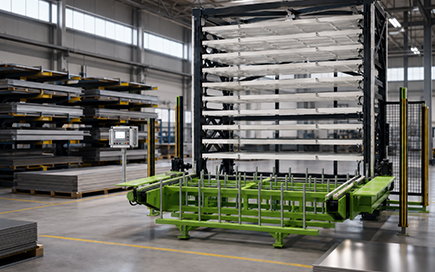
Horizontal racks and automated storage towers can both protect sheet materials when correctly configured, but they serve different operating environments.
| Comparison Factor | Horizontal Sheet Rack | Automated Vertical Storage System |
| Use of space | Requires more floor area as inventory grows | Uses workshop height to increase storage density |
| Material retrieval | Usually depends on forklifts, cranes or manual handling | Selected trays are delivered to an access position |
| Inventory organization | Often managed through labels and manual records | Tray positions can be recorded through the control system |
| Access speed | Suitable when retrieval is infrequent | Better suited to frequent material changes |
| Initial investment | Generally lower | Higher due to lifting, control and safety systems |
| Expansion | Additional floor space is usually required | Capacity depends on tower height and tray arrangement |
| Suitable users | Small workshops and low-volume storage | Factories with limited space or frequent sheet retrieval |
A horizontal rack may be sufficient when a workshop stores only a small number of sheet types and retrieves them occasionally. It is easier to install, does not require complex controls and may fit businesses with limited capital budgets.
Automated storage becomes more attractive when floor space is constrained, material variety is increasing or operators repeatedly move sheets between storage and production. A sheet metal vertical lift can also improve workflow by bringing stored trays to a consistent access height rather than requiring operators to reach into deep racks or move upper stacks.
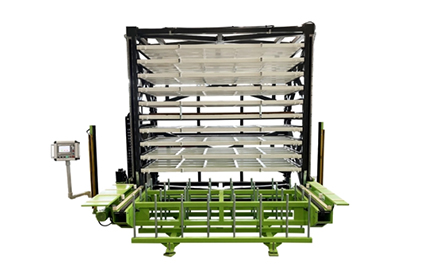
Vertical storage equipment should be selected according to the actual sheet inventory, not only the outside dimensions of the machine. An undersized tray limits future material options, while an oversized system can increase cost without improving daily operations.
Before requesting a configuration, buyers should confirm:
Maximum sheet length and width
Material type and density
Maximum sheet thickness
Maximum weight stored on each tray
Required number of trays
Available workshop height
Floor loading capacity
Required loading and unloading method
Tray size should provide enough clearance for the largest sheet while avoiding unnecessary unused space. Load capacity must include the combined weight of all sheets placed on one tray, not only the weight of a single plate.
For example, a plant storing several grades of carbon steel may allocate separate trays by material grade and thickness. Frequently used sheets can be positioned in trays that are retrieved more often, while lower-demand stock can remain in less frequently accessed positions.
Machine height should also be evaluated together with ceiling clearance, lighting, ventilation, overhead cranes and fire-protection systems. The tallest machine that fits the building is not automatically the best option. Tray count, retrieval frequency and future inventory growth should be considered together.
Sheet metal is heavy, has sharp edges and can shift unexpectedly during handling. Storage planning should therefore consider how sheets enter the system, how they are removed and how operators transfer them to downstream equipment.
Important safety and workflow factors include:
Rated tray load and total machine capacity
Controlled tray movement
Emergency stop and safety interlocks
Access-zone guarding
Sheet alignment and anti-sliding measures
Forklift, crane or vacuum-lifter access
Clear separation between operators and moving components
Horizontal racks may require forklifts or overhead cranes to move sheets from different levels. This can create additional travel paths and may interrupt nearby production. Automated storage reduces some of this movement by bringing the selected tray to a fixed loading station, although the final transfer method must still match the sheet weight and downstream process.
In an automated vertical warehouse, tray identification and material records can form part of a more controlled storage workflow. However, inventory accuracy still depends on operators correctly recording material grade, thickness, quantity and tray position.
The best system is the one that matches actual material flow. A highly automated tower may not be necessary for a workshop retrieving only a few sheets per day, while a simple rack may become inefficient in a facility processing many material types across multiple shifts.
A horizontal rack is usually more suitable when:
Inventory volume is limited
Floor space is readily available
Material retrieval is infrequent
Existing lifting equipment can access the racks safely
An automated vertical storage system is usually more suitable when:
Workshop floor space is limited
Many sheet grades and thicknesses must be separated
Materials are retrieved frequently
The storage system is positioned close to cutting or forming equipment
Inventory organization and controlled access are priorities
Before purchasing, buyers should provide the supplier with sheet dimensions, material types, thickness range, tray load, tray quantity, building height, retrieval frequency and loading method. The supplier can then determine the tray dimensions, lifting capacity, tower height, control arrangement and safety configuration.
The decision should not be based only on storage capacity. Installation access, foundation requirements, maintenance space, electrical supply and the route between storage and production equipment must also be reviewed.
Typical materials include carbon steel, stainless steel, aluminum, galvanized steel and other flat metal sheets. Tray load and dimensions must be selected according to the material weight and sheet size.
No. A vertical rack normally stores sheets upright in fixed compartments, while an automated storage system generally stores sheets horizontally on powered trays inside a vertical tower.
The required number depends on how many material grades, thicknesses and sheet sizes need to be separated. Buyers should also allow for production growth rather than calculating capacity only from current inventory.
Some projects can be configured for integration with cutting or material-handling equipment, but the connection method depends on the storage design, machine layout and loading system.
Suppliers normally require the maximum sheet size, material type, thickness range, weight per tray, tray quantity, workshop height, loading method, retrieval frequency and local electrical standard.
A horizontal rack may be more economical when inventory is limited and floor space is available. Automated vertical storage is more suitable when space, retrieval efficiency or inventory organization has become a production constraint.
Horizontal sheet racks provide a practical, lower-cost solution for simple and low-volume storage. Automated vertical systems offer better use of building height, controlled tray retrieval and more organized material access for space-limited or high-activity workshops. The final choice should be based on sheet dimensions, tray loads, retrieval frequency, building conditions and the complete workflow between storage and production.
This is the first one.